
A map designed solely for the Chinese market is beginning to leave traces well beyond its borders. For AMD, this would open an additional door in the upper mid-range, at a time when the commercial situation for Radeons remains tense in China.
The Radeon RX 9070 GRE discreetly leaves the Chinese framework
Several clues point to a wider diffusion of Radeon RX 9070 GRE via AMD’s global distribution network. The most visible comes from an image of a Sapphire Radeon RX 9070 GRE PULSE whose packaging adopts branding in English, far from the names usually used by Sapphire for the Chinese market.
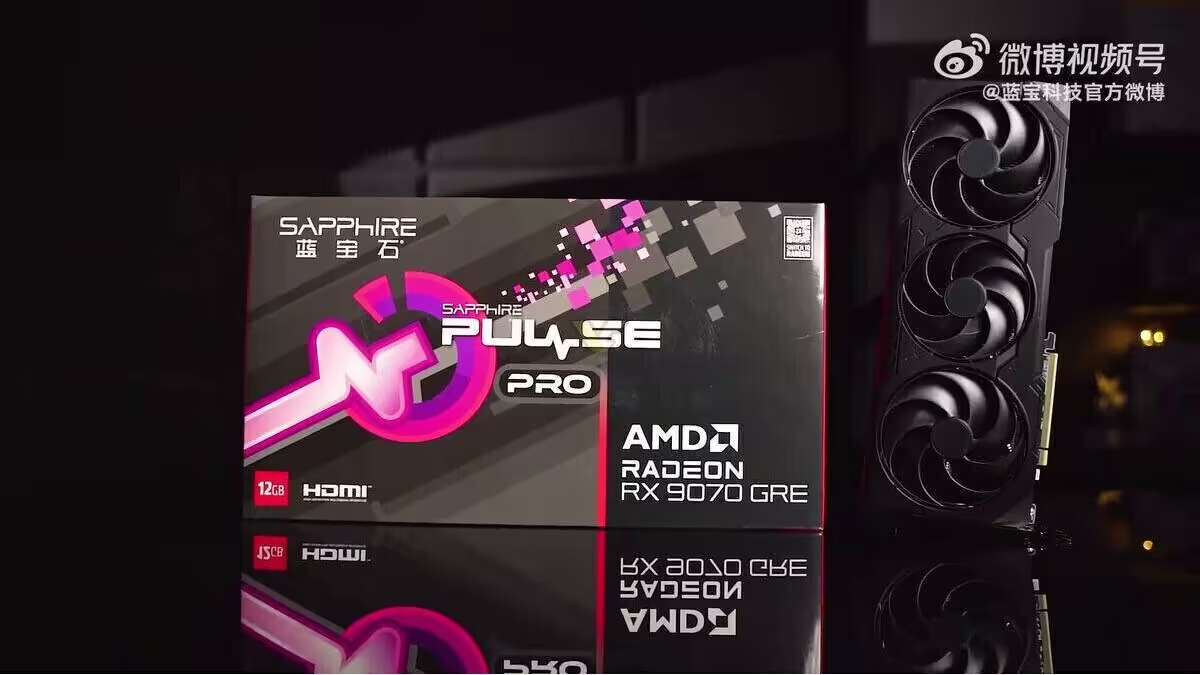
To better situate this rumor of international opening, just look at how Sapphire is already declining the card on its original market: the Radeon RX 9070 GRE and RX 9060 distribution finally align.
Another signal, pre-assembled PCs equipped with Radeon RX 9070 GRE have appeared on Newegg, as have unofficial sheets for the card itself. Sapphire’s PULSE and PURE models are mentioned there, although these listings so far come from Chinese third-party sellers and not official distributors in the United States.
A known configuration, with Navi 48 XL and 12 GB of GDDR6
AMD launched the Radeon RX 9070 GRE about a year ago exclusively for China. The card is based on a Navi 48 XL GPU with 3,072 Streaming Processors distributed over 48 Compute Units, accompanied by 12 GB of GDDR6 on a 192-bit bus for a bandwidth of 432 GB/s.
The technical positioning of this GRE also takes on its full meaning if we place the card in the RDNA 4 range already analyzed: the detailed test of the Radeon RX 9070 GRE highlights its 12 GB of VRAM and its design limits, two key elements to understand its interest in a broader market, especially if AMD seeks to sell more Navi 48 XL chips.
Custom versions of Sapphire, notably the PURE and PULSE, benefit from a factory overclock which significantly exceeds the reference boost clock set by AMD at 2790 MHz. The precise specifications of the recently spotted Sapphire Radeon RX 9070 GRE PULSE are not yet detailed, but a factory overclock seems likely.
A possible enlargement against a backdrop of commercial pressure
This potential international opening could also respond to a logic of destocking or preparation for a future launch. Earlier this month, several AMD graphics cards were sold at a loss in China, with some distributors in the channel even conceding losses on several Radeon models.
At this stage, nothing is official. But between the packaging in English, the presence on Newegg and the multiplication of references not visually limited to the Chinese market, the hypothesis of marketing outside China becomes difficult to rule out.
If AMD really validates this extension, the maneuver would make sense: a 12 GB card on a 192-bit bus can still find its place among the references already installed, especially if the manufacturer seeks to better sell Navi 48 XL chips in a context of margins under pressure.
Source : TechPowerUp