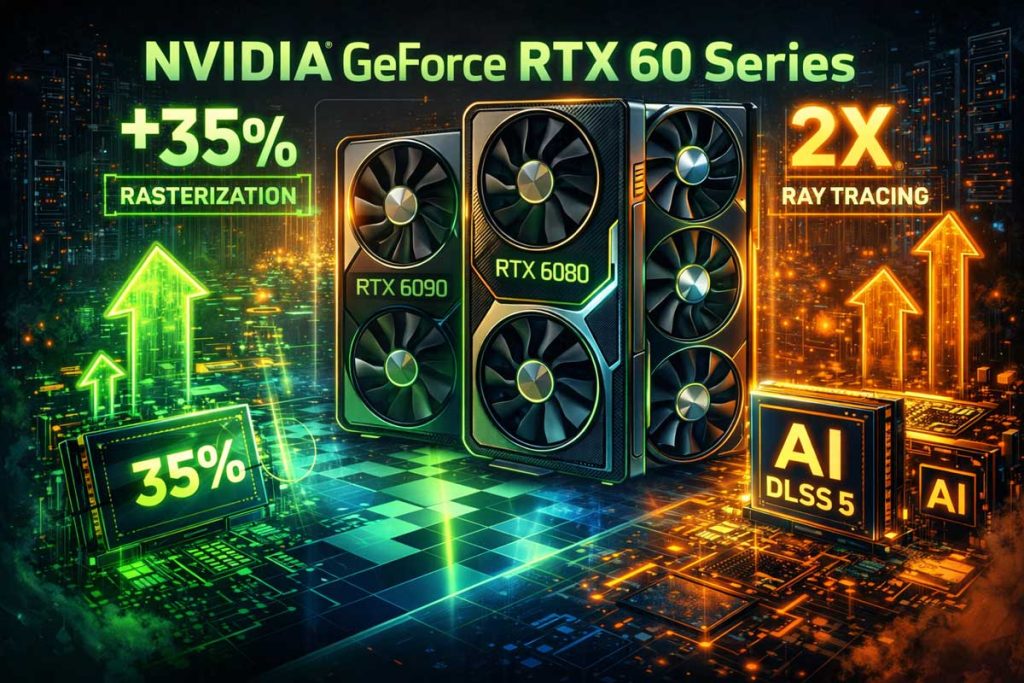
New information is beginning to circulate about the upcoming NVIDIA GeForce RTX 60 graphics cards and their Rubin architecture. While the gains in performance may be relatively modest, the true generational leap could lie elsewhere: in ray tracing and path tracing, where NVIDIA is aiming for a spectacular jump.
RTX 60: moderate improvement in rasterization, but massive in ray tracing
According to the latest industry leaks, the RTX 60 cards are expected to offer an improvement of between 30 and 35% in traditional rasterization compared to the RTX 50 cards based on the Blackwell architecture. While this is a notable gain, it falls short of a major breakthrough.
On the other hand, when it comes to ray tracing, NVIDIA is preparing a much more ambitious leap, with performance potentially doubling in this area. This progression is made possible by the introduction of 5th-generation RT cores and 6th-generation Tensor Cores, designed for AI-related tasks and advanced rendering.
Increased specifications, but no memory revolution
In terms of technical specifications, several models are beginning to take shape. The GeForce RTX 6090 is rumored to be based on a 3nm TSMC GR202 GPU, with 24,576 CUDA Cores, approximately 13% more than the RTX 5090. It is expected to retain a similar memory configuration with 32GB of GDDR7 on a 512-bit bus.
The RTX 6080 and RTX 6070 are also expected to see improvements in bandwidth. The former could feature 20GB of GDDR7 with a 320-bit bus, while the latter may offer 16GB on a 256-bit interface. Although the exact number of cores remains unknown at this stage, the increase in memory bus and capacities hints at an interesting gain in bandwidth.
An architecture designed to support DLSS 5
Beyond the numbers, these advancements fit into a broader logic: to accommodate the arrival of DLSS 5. This new generation of technology is not just about image reconstruction but is moving towards AI-assisted rendering.
The early demonstrations have required extreme configurations, with two RTX 5090 cards working together: one for rendering, the other for neural processing. This approach underscores the high power requirements involved.
In this context, the RTX 60 cards appear to be the first GPUs truly designed to efficiently harness this technology. With an increase in IPC, better Tensor Core management, and enhanced ray tracing power, they should make DLSS 5 viable on a single graphics card.
Uncertain launch timeline
The question remains regarding the launch timeline. While some sources mention a possible arrival in the second half of 2027, others do not rule out a delay to 2028 due to the challenging industrial landscape, marked by memory shortages and the priority given to AI infrastructure.
In any case, these initial details outline a generation of GPUs less focused on raw power and more on algorithmic efficiency. It is a logical transition as AI gradually becomes the core of graphic innovation at NVIDIA.