Return to Part 1: Dumpster Diving
Continued from Part 52: What Am I Going to Do With All This Cheese
Few Linux games can claim to have as gone as native as Lugaru: The Rabbit’s Foot. Developed by David Rosen and released under his Wolfire Games label in January 2005, Lugaru debuted as one of the many games to be birthed by the once vibrant Macintosh shareware scene, before being ported to Microsoft Windows in May 2005 and then finally brought over to Linux in August of that same year thanks to efforts of the prolific Ryan “icculus” Gordon.
From there Lugaru would go through several more evolutions, the first of which was the game being rebadged as Lugaru HD following the official adoption of a fan made high resolution texture pack assembled by Tim Soret. This was the version of the game which would go on to be included in the inaugural Humble Indie Bundle in May 2010, the overwhelming success of which would see Lugaru HD have its source code released under the GNU General Public License as a thank you to its backers.
Wolfire Games then started work on a sequel titled Overgrowth, which after nine long years of development left early access in late 2017, and featured a full reimplementation of the original Lugaru campaign. With this done, Wolfire Games were generous enough to also release the Lugaru game assets under the CC BY-SA 3.0 licence, allowing it to exist as a completely free game. OSS Lugaru, the leading community branch, is now widely packaged in many Linux software repositories.
I cut my teeth with Lugaru HD, after the game was no longer sold as shareware, but given its minimal hardware requirements, I grew curious about how far back I could get the game to run. Indeed, the initial Lugaru website from 2005 claims that the game “should run at full speed at full detail on any system with a 700 mhz processor and Geforce 3 or better graphics card”, but that it should also “run acceptably on any system with a 300 mhz processor and Rage 128 or better graphics card”.
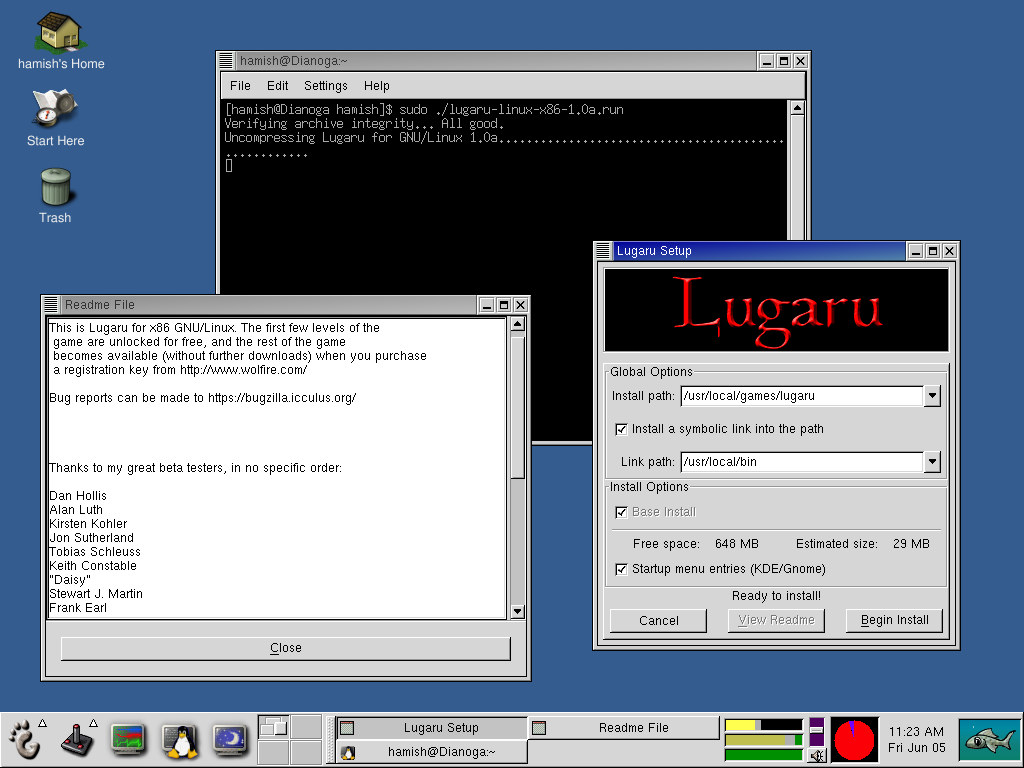
With my recent upgrade from a Rage 128 Pro to a Geforce 2 MX 400, Dianoga now falls right in the middle of those two poles. Being shareware made it trivial to find the maiden Linux binaries distributed in the lugaru-linux-x86-1.0.zip archive, which offers a graphical installer providing both the demo and the full game locked behind a registration key. Being from 2005 the Linux port demands a newer version of libstdc++ than came with my distribution, but third party RPM packages can address this.
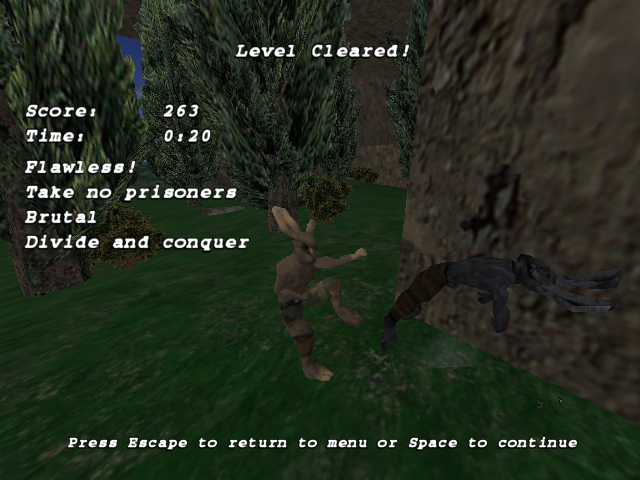
Game performance was indeed acceptable, with the greatest headache being the animated screen transitions, which I can also remember bogging things down for me much later on in the early days of the free Radeon drivers. Once inside the game world proper things stayed fluid for the most part, even with the detail settings set to high, although I did lower the quality of the blood effects and disabled blur effects and decals. I also had to keep the screen locked at a modest 640×480 resolution.
From there I needed to get my hands on a registration key, which David Rosen very kindly provided for me even without having access to the original key generator, taking the trouble of reconstructing the logic used to produce the keys instead. Too many digitally distributed Linux games from this era are now in danger of becoming lost media, and while Lugaru itself of course has since become ubiquitous, it was refreshing to find how easy a process this all could still be.
As for how well the game plays, Lugaru was very much how I remembered it: a promising first draft of something which had yet to reach the full potential of its premise. The game’s context sensitive fighting system is genius, and the greatest knock one can make against the game is that not enough was done to take full advantage of it. The story campaign is competent but left basic, with larger themes hinted at but never given any greater exploration other than brief asides.
Lugaru thrives on lateral thinking, epitomized for me with the final Challenge level, which has you face three tough wolves with no weapons on hand other than your bare paws. I could take down the first wolf without even taking damage, but my luck would always run out when tangling with either the second or third. Inspiration struck when I realized I could hurl the corpse of the first wolf at the other two for massive damage, flipping the stage from seeming impossible to beatable in just two strikes.
The game has good bones, so it make sense why Wolfire Games took as long as they did to flesh things out with the sequel, but I will admit that Overgrowth was in early access for so long I had already moved on to other things by the time it grew into its final form. Perhaps it is long past time that I rectified that, but that is certainly not going to happen on a 500 MHz Pentium III processor and 512 MB of PC133 RAM. Or with a six sided dice and pen and paper.
Carrying on in Part 54: Character Building
Return to Part 1: Dumpster Diving