“Living” video games, robots capable of understanding tasks for which they were not programmed, AI agents who look for security vulnerabilities in companies: generative artificial intelligence has indeed freed itself from robot dialog boxes conversational. Here are four trends observed at the Google Cloud Next 2026 conference.
“Living games” are coming
After the transition from 2D to 3D, then from traditional games to games as a service, is the gaming industry experiencing a new big transition with the arrival of generative artificial intelligence (AI)?
That’s what Jack Buser, an industry veteran who is the global director of video games for Google, believes. His team even found an expression to describe this new generation of AI games: living games (“living games”). living games HAS”). In this vision, AI is used in particular for game management (everything related to monetization and publishing, for example), for game development (using AI to facilitate quality control before launching a game) and the use of AI in games directly.
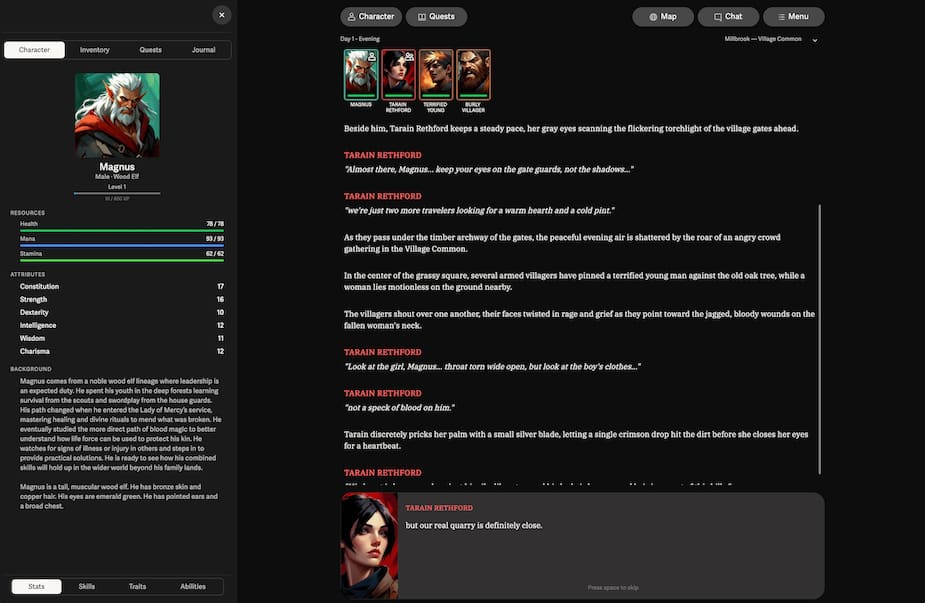
Capture d’écran : Latitude
The AI travel role-playing game was presented at the Google Cloud Next show.
“Several demos and features have already been demonstrated, but obviously games take years to develop, so this is just the beginning. But what is coming over the next few years is truly incredible,” said the manager, met on the sidelines of the Google Cloud Next conference.
In practice, we can expect non-player characters who can chat thanks to AI, for example, but also crowds managed by AI, character customizations thanks to AI and game mechanics that use AI directly.
Among the challenges developers face right now: ensuring that AI games can run at low cost. “It’s a discussion we have with all developers,” admits Jack Buser.
Several ways are being tested by different studios to ensure that future live games do not consume too much computing power, such as having an online AI that controls several smaller local AI agents, which would in turn operate thanks to a console’s graphics card. A local AI could also perform some basic tasks, then transfer only more complex conversations to the cloud.
“It’s hard to realize it when you’re in the middle of it. But once the transition we are currently experiencing is complete, we will realize that the entire industry has changed: from the types of games we played, to the teams who created them, to the video game business model. This is what is happening today,” notes Jack Buser.
Smarter robots
Robots have existed for many years in an industrial context. These are generally developed specifically to carry out specific tasks, or else trained or programmed to carry them out after their acquisition.
Generative AI models should help simplify the deployment and use of these robots. In a demonstration at Google Cloud Next, the German manufacturer Franka Robotics, for example, presented a robot capable of sorting objects, even if it had not been trained for this task.
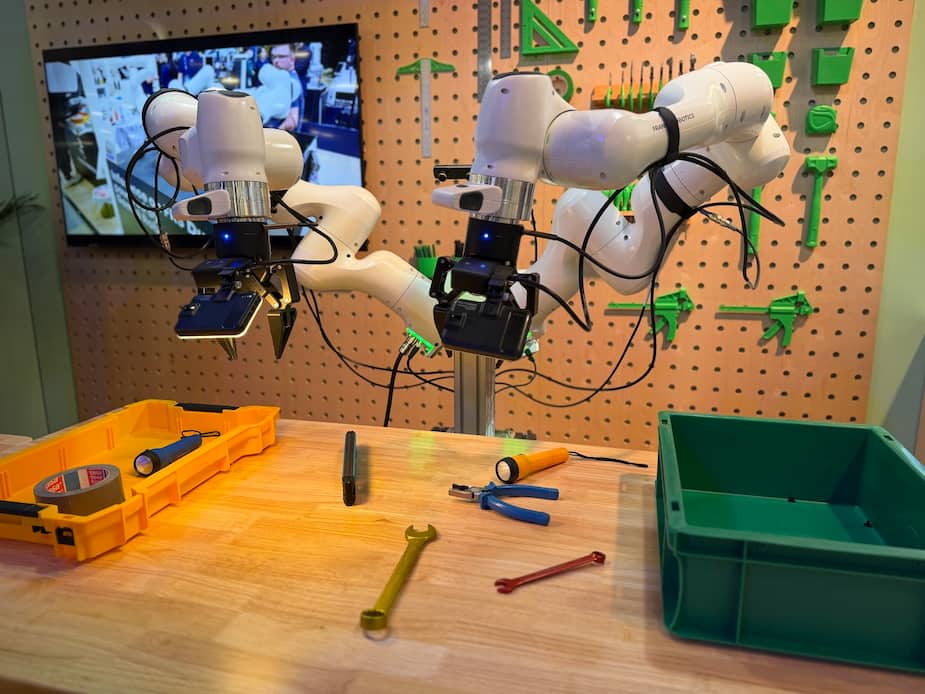
Photo : Maxime Johnson
Le robot Franka Research 3 de Franka Robotics.
To interact with the robot, simply chat with it in a dialog box. And since it uses an AI model like Gemini, there is no need to explain to it what a wrench is if you ask it to pick it up, for example. “It will also recognize by default all the other ways and synonyms that someone can use to describe an object,” observes Tatiana Zakharova, marketing director for Franka Robotics.
Another robot demonstrated at the show was that of the French company Enchanted Tools, a cute little robot with which it was possible to chat about anything and everything (I asked him to say hello to the students in my daughter’s class in a video, for example, a task for which he certainly did not have been programmed!), which makes it an ideal device in hospitals, for example, for chatting with patients.
“It can also perform tasks, such as carrying objects or pulling a cart,” notes Richard Malterre, communications manager for Enchanted Tools.
In certain cases, AI also makes it possible to enhance existing robots. Spot, the yellow robot dog from Boston Dynamics, for example, recently received an update allowing it to use Gemini AI to automatically perform different tasks that would have had to be programmed with a lot of effort until now.
In practice, AI should make robots more efficient by default and easier to use, which may make them more attractive to businesses, and possibly to consumers, when models for the general public arrive.
Security: when AI agents face other AI agents
For several years we have been talking about the risks of hackers using AI for fraud and computer attacks, but we are talking much less about the other part of the equation: AI computer defenses.
At Google Cloud Next, Wiz, for example, presented its three new AI agents, the “red agent”, the “blue agent” and the “green agent”, names which use the usual classification given to certain IT security teams.
The red agent can thus try to find flaws in a system, the blue agent identifies intrusions and prioritizes the flaws found by the red agent, and the green agent corrects them.
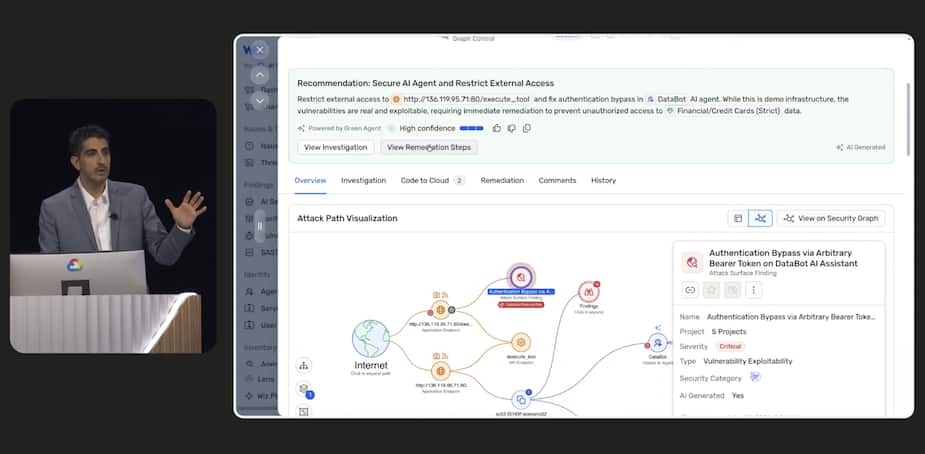
Capture d’écran : Maxime Johnson
Wiz co-founder Yinon Constica, at Google Cloud Next.
The arrival of generative AI in computer defense could also reverse a fundamental trend in the industry, believes the co-founder of Wiz Yinon Costica. Indeed, traditionally, in the mouse game of computer security, attackers generally start one step ahead of those who must defend themselves and who do not know where the next attack will come from.
“As defenders, we can use AI on ourselves, with good knowledge of our system. We can therefore finally take advantage of the first movement, and really have a chance of winning by getting ahead of the threats,” explains Yinon Costica.
Models are increasingly (partly) taking a back seat
Cloud tech conferences are all a bit similar, but there was something different this year at Google Cloud Next, compared to other conferences since the advent of generative AI: AI models were much less front and center than before.
Part of this is obviously because Google Cloud has a much broader range of products than just AI models, but the presentations on AI agents – the hot topic in computing – weren’t really about the capabilities of these agents, but rather about the technologies and tools to deploy them on a large scale and to secure them, for example.

Photo : Maxime Johnson
Even among the exhibitors encountered at the show, virtually none were limited to Google models, and most instead emphasized the importance of being able to easily switch from one model to another.
This trend also reminded me of the change in the habits of phone manufacturers a few years ago, who had stopped placing emphasis on the technical sheets and characteristics of their devices, to instead concentrate on what it was possible to achieve with them.
For businesses, the challenge in 2026 is no longer to imagine what to do with AI, but rather to implement it. And the challenge for tech giants is no longer to push its limits, but to ensure that it can keep its many promises.
This article was written as part of a press trip, part of the costs of which were paid by Google, without any right to review its content.




/2026/06/19/6a3506cdd65e3129744168.jpg "Deux personnes sont mortes dans des frappes russes en Ukraine, dont une enfant de 8 ans")