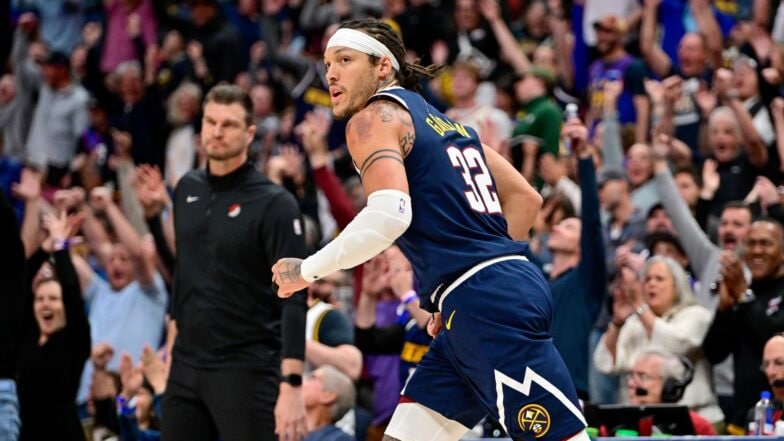
Aaron Gordan switched his jersey number from No. 50 to No. 32 in honor of his late brother Drew.
Editor’s Note: Read more NBA coverage from The Athletic here. The views on this page do not necessarily reflect the views of the NBA or its teams.Â
***
Aaron Gordon kept coming back to the canvas, back to the brush. Day after day, painting what he felt. What seemed stuck inside. What he couldn’t express on the basketball court — or anywhere else.
He called the painting “Caged Bird.â€
“It’s about following the present moment,†Gordon says, “to avoid being trapped.â€
When he’s painting, he feels some peace. Normalcy. Unlike much of the outside world, things seem to make more sense here. In a room by himself, painting, he doesn’t have to be perfect. He doesn’t have to perform. There is no one to impress.
It’s just “me, the canvas and my thoughts,†says Gordon, a Denver Nuggets forward.
The practice comforts him. “Being able to take out that emotion, and create something beautiful with it,†Gordon says. “Before painting, it’s almost like there’s an angst, and almost like an anxiety … and then you just flow, your picture starts to come to fruition. It’s this level of fulfillment, almost like a release.â€
He had only taken one art class in high school and had no extensive knowledge of oil painting. But he loved the challenge of something new. He began to think about the deeper intention behind his creations; why he was becoming so meticulous with each stroke. Why he was trying to find beauty in each painting, no matter how far each strayed from his original idea.
He realized painting was less about the product and more about the experience. About what his soul needed. Which led him to “The Caged Bird.â€
“It came at a time when I felt like I was stuck spiritually,†Gordon says.
It’s been almost two years since Gordon’s brother, Drew Gordon, was killed in a car accident at age 33. He was a kind soul, an older brother who Aaron trusted. Confided in. Hoped to emulate. Drew was his inspiration, the one who showed Aaron how to live a fulfilled life. The two were best friends. Drew was a basketball player, too, who played for the Philadelphia 76ers for a brief period, had various stints in the G League, and enjoyed a successful professional career overseas for many top-tier teams. Drew beamed, watching Aaron and the Nuggets win the 2023 championship. Aaron would not have gotten there without the wisdom of his big brother. After his death, Aaron changed his jersey from No. 50 to No. 32, the number Drew wore at the University of New Mexico, to honor him.
The loss is a grief that Aaron is still wading through. Still processing. It has given him a greater appreciation for the present. “You can’t really know life without death,†Gordon says.
He finds purpose, meaning and even joy in a variety of activities, including reading, playing the piano, meditating, making music, interior designing, painting and working out in a home gym he built.
And he takes pride in his role as a leader for the Denver Nuggets, now facing the Timberwolves in the first round of the playoffs, intent on chasing a championship despite numerous players battling nagging injuries and missing time on the floor, including superstar Nikola Jokić.
The Nuggets took Game 1, 116-105, behind 30 points from Jamal Murray. The Timberwolves clawed back in Game 2, as Anthony Edwards took over with 30 points and 10 rebounds in the Timberwolves’ 119-114 win.
Gordon has missed portions of the season due to a right hamstring injury, but he has found his niche as a heartbeat of this team. “AG is definitely the glue,†guard Kentavious Caldwell-Pope says. He’s also the team’s calm. The even-keeled veteran. “Everybody looks to AG as far as keeping everybody under control,†Caldwell-Pope says.
With so much in his personal life outside of his control, he has come to focus on what is in his power: nourishing his relationships with teammates and having a deeper gratitude for his family, and his own life. That, in turn, has helped him process unspeakable loss. “Grief is a tough one because there’s not a ton of stuff that you can do. You can’t go around it,†Gordon says. “You can’t go over it or under it. That’s just one of those things that you gotta go through.â€
As with his paintings, he has learned to find beauty wherever he can. The glimmers others take for granted. The jokes in the locker room, the wisdom he can impart to the Nuggets’ younger players. The passages in the dozens of books that line his study (he plans on attending law school). The Jean-Michel Basquiat prints on the skateboards that hang along his study’s walls.
The many outlets he uses to express himself, beyond basketball, have taught him balance.
“It puts things into perspective,†Gordon says.
Before every game, Gordon usually has a message for his teammates: “Throw away everything — all the luggage, all the emotional baggage,†according to guard Peyton Watson. “Throw that away before we go out there, and let’s just go out and have fun and play the game, respect the game, and play it how it’s supposed to be played.â€
Watson considers Gordon a mentor. “AG is the vocal leader of our team,†Watson says. “ …He’s really, really good at living in the moment, and being present.â€
That’s been an area of focus for Gordon, who has been inspired by the books that he reads across a range of disciplines, including eastern philosophy and transcendental meditation. “A friend of mine said three weeks of reading solves three months of problems,†Gordon says.
The classic “Tao Te Ching†by Lao Tzu has deeply influenced him. The Tao, or The Dao, meaning “The Way,†is about how to live in harmony with the natural flow of the universe. And that involves embracing dualities — one of the biggest influences on Gordon’s mindset — and how seemingly opposites create harmony.
“I’m a firm believer in the Daoism, the Yin and the Yang,†he says.
The translated text reads:
For being and nonbeing
arise together;
hard and easy
complete each other;
long and short
shape each other;
high and low
depend on each other;
note and voice
make the music together;
before and after
follow each other
“You can see the things that are going wrong in your life, and what you think are wrong — this incorrect thought process — and then try to find out what the silver lining is. You can always do it. You can always do it,†Gordon says.
“There’s people that refuse to do it,†he continues, “because they want to attach their personality and their character to loathing, and being miserable, and suffering, but if you’re open-minded and you feel like, OK, I really want to get out of this, you can see the good in everything bad.â€
He has managed to apply that principle to his own life, with his own grief, finding silver linings — dualities — in the inexplicable. Joy, he has learned, still accompanies sadness; as does understanding and uncertainty. “Losing my brother,†Gordon says, “and gaining a relationship with my nephews.â€
He feels tremendous joy in being Uncle Aaron, as his nephews call him. He has helped raise them, and their bond has grown deeper over the last two years. He makes sure to roughhouse with them — like brothers do. “My brother was a fighter (Yang),†Gordon says, “I am a lover (Yin), and I just make sure to beat my nephews up from time to time to make sure the Yang energy is balanced. For me, Yin is passive. Yang is active.†He’s joking, but it is that playful spirit, that perspective, that has kept all of them going.
He thinks of another duality, another Yin and Yang: “Losing my brother,†he says, “and understanding what life is really about.â€
“There is no single answer to the meaning of life because we all have different experiences and live life in unique ways,†he says. “Part of life’s beauty is discovering what it means to you. For me, life is about cherishing the time we spend with the people we love most, pursuing your dreams, and helping others pursue theirs.â€
His teammates can feel that sentiment each day.
“Everyone gravitates toward him,†Caldwell-Pope says. “AG was a great example as far as the younger players … [letting] them know, ‘Just be patient. Your time is coming. You never know what can happen. Just be ready.’â€
That mindset has been especially important on a team with two franchise cornerstones in Jokić and Murray. “All his teammates respect him,†says Elise Gordon, his older sister. “He’s always willing to share knowledge without judgment.â€
When Watson first joined the team in 2022, Gordon immediately took to the rookie and welcomed him into his home, and introduced him to his family. Gordon wanted him to know that the older veterans had his back.
Gordon realized Watson needed confidence. “He’s always told me to be big with my intentionality and my aggression when I step out there on the court,†says Watson, who remembers feeling just the opposite his first year. “Just being more tentative and being more hesitant to be my full self out there … I wanted just to do everything perfectly.
“And AG told me to just go out there and be myself,†Watson continues. “Try to do things the way you do them, and that’s gonna be what’s most comfortable for you and what’s gonna benefit you most in the long run.â€
It’s a message for all his teammates: “My best wisdom I’ve shared is, ‘Don’t be afraid to make mistakes; play to play great, not to avoid making mistakes,’†Gordon says. It is something he holds himself to, often reminding himself of a mantra that resonates with him: “I am not above or below no man. Everyone is on an equal playing field.â€
His confidence has allowed his own game to evolve since he came into the league in 2014, spending the first seven seasons of his career with the Orlando Magic before being traded to the Nuggets in 2021. He’s transformed from a high-flying, dynamic forward to a more fundamentally sound X-factor on a championship team, able to create for himself from 3 or dish to others, and rebound and defend at an elite level. With more years behind him than ahead of him in the league, perhaps his biggest contribution these days is his voice. “Acquiring knowledge to pass down to the next generation is what I’m doing this for,†Gordon says.
Part of his leadership, though, has been allowing his teammates to lead; to be there for him, too. Many flew to Oregon to be there for him for Drew’s funeral. “Drew was such a great dude,†Watson says, “Drew would be so supportive and show up to every game, show up to every event that AG was a part of … It was just something so abrupt that broke my heart … I could only imagine how devastated AG was, and that was our entire team trying to just brainstorm and think of ways that we could try to continue to lift his spirits and just be there for him as brothers.â€
Caldwell-Pope admires how Gordon carried so much inside but didn’t let it affect his play on the floor. He was still going to show up, full effort, every possession, even helping the team to a second-place finish in the West before falling in the Western Conference semifinals in seven games in 2023-24. “He didn’t bring his grief to the locker room,†Caldwell-Pope says. “When he came to work, it was all about work. And when he left, you knew it was all about his family.â€
Gordon began to come to terms with what had happened. “Accept a reality for what it is,†Gordon says. He turned to his books, particularly on the subjects he’s passionate about, including metaphysics and astrophysics. These disciplines contemplate existence beyond the world we commonly know.
“Believing that the spirit never really leaves. Energy is neither created nor destroyed,†he says. “The energy, after losing somebody, the energy is still with you, it’s still carried with you, it’s still around, it’s still guiding you. They’re still here.
“Even though you can’t see him or touch him,†Gordon says, “you can still feel him.â€
While his teammates praise his ability to stay in the moment — to be the X-factor for this team as it moves forward in the playoffs — Gordon sees beyond this moment, too. He isn’t likely to be someone who struggles to retire, to define himself without the game. He has always done so — in his own way. His canvas, his books, remind him that his purpose has always been bigger than basketball.
“When it’s done,†Gordon says, “it’s done. And I’ll let it go.â€
“[These other mediums] remind me not to take basketball so seriously,†Gordon says. “Basketball is just another medium for me to express myself. … [but it] just reminds me that there are other ways to express yourself in this world.â€
One of those ways is through gratitude. He has found that once you start looking for good — you start to notice it more. Sometimes you find it everywhere. “Turns out,†Gordon says, “you literally never have to repeat one thing. There’s an infinite number of things to be grateful for.â€
He is grateful for his meditation practice, too, and the ability to find his calm. For himself, and for this team. He meditates four or five times a week, for about five minutes each. He isn’t concerned with the time, or having a set schedule. “Meditation is about the breath and the presence of body and mind,†he says. “If it takes an hour, it takes an hour; if it takes five minutes, it takes five minutes.â€
He has launched “Mental Game,†a guided meditation series in partnership with UC Health that gives people access to the same mindfulness tools he uses. Kids, he says, can benefit from the practice, too. When he meditates with them, he guides them through a visualization practice, telling them to imagine lying in a field and feeling the grass underneath; or lying under a lemon tree, picking a lemon, and taking a bite. “Most kids say they can taste the lemon,†he says.
“It helps kids and others understand how powerful the mind can be,†he says. “Life is full of ups and downs, and meditation helps regulate emotions and create space to be calm.â€
He remembers one of his mantras these days: “I have nothing and everything.â€
It is a silver lining, this ability to recognize his power and his limitations; his strength and his weakness. And so he paints.
Me, the canvas and my thoughts.
***
Mirin Fader is a senior writer for The Athletic, writing long-form features, primarily on the NBA. Mirin is also the New York Times best-selling author of GIANNIS: The Improbable Rise of an NBA Champion and DREAM: The Life and Legacy of Hakeem Olajuwon. She has told compelling human-interest features on some of our most complex, most dominant heroes from the NBA, NFL, WNBA and NCAA, most recently at The Ringer. Her work has been featured in the Best American Sports Writing books. She lives in Los Angeles.