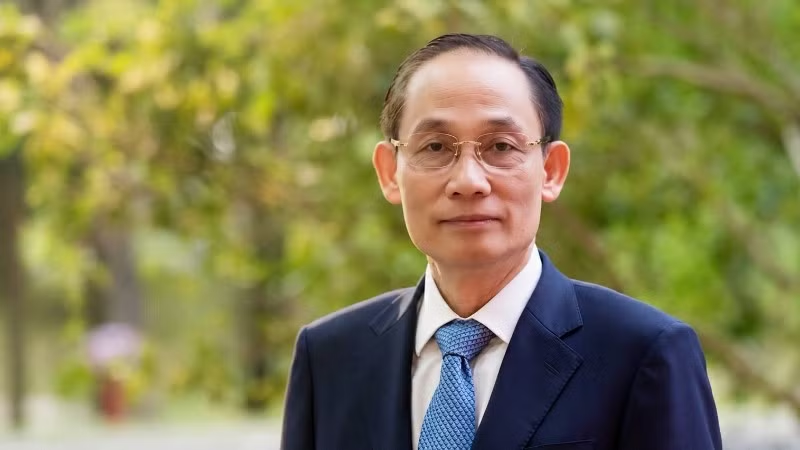
Thomas Gomart is a respected voice on international issues. Since 2019, the director of Ifri (French Institute of International Relations) has published no less than four books that depict the world’s turmoil. However, in recent months, when he meets with business leaders, the head of the think tank has made a habit of reading them another work: the National Strategic Review (RNS), unveiled last July by the government, which lays out the threats facing France.
Thomas Gomart highlights article 7 of the introduction. This article raises the “particularly high risk of a major high-intensity war outside the national territory in Europe, involving France and its European allies, by 2030, and would see our territory targeted at the same time by massive hybrid actions.”
In clear terms, the central scenario is a war with Russia within 4 years on European soil where the French army would be involved, with severe consequences (sabotage, cyberattacks, disinformation actions, etc.) on national soil.
“When I read that, it is not uncommon for me to be asked to repeat it,” smiles Thomas Gomart. A recurring situation from which he has drawn a lesson: “Today, I see a strong discrepancy between what the strategic and military community thinks and what the business world says about the evolution of the world.”
Indeed, there is a dissonance. Everywhere in the world, the sounds of boots are echoing. The latest report from the IMF (International Monetary Fund), published in mid-April, expresses concerns about the increase in wars. But have French business leaders taken note?
[…]
This contrasts with part of the Old Continent. In the Netherlands or the Baltic States, telecommunications operators are working together to protect data centers in case of missile attacks.
“If geopolitics is back, the scenario of a major conflict remains in the shadows. How to understand this in-between? The reason is primarily psychological – it is never easy to accept the end of a world.”
This is also the conclusion that Thomas Gomart draws: “Many have experienced what I call an ‘airport globalization.’ In a secure Europe, it was tempting to believe in the dictates spread in the corridors of Davos.
“A whole prospective literature contented itself with extending the major global trends in an disembodied, partial, and biased manner, putting aside ideological or religious questions,” sums up the director of Ifri. In this collective imagination, Russia was not supposed to invade Ukraine because that was not in its “interest.”
“The temptation of ‘business as usual’ is all the more significant as multinational companies have shown, in recent years, great resilience to multiple crises by diversifying their supplies and locations on all continents.”
Cybersecurity – which is at the top of the list on the risk map drawn up annually by major groups – also receives substantial investments.
“In a country that has seen its long-standing tradition of hybridization between senior civil servants and captains of industry erode, cultural shock with the Army is inevitable. The presence of military personnel in corporate boardrooms remains limited.”
> Read the full article on the Echos website.
/2026/06/16/6a30e890a0c81564235057.jpg "Environ \"120 millions de barils encore coincés\" dans le détroit d'Ormuz, selon un expert")

/2026/06/19/6a3532d63e01d848161497.jpg "REPORTAGE. Au plus grand salon mondial de larmement, larmée opte pour le 100% Français")