
Lenovo forgot to properly lock an internal portal, and everyone saw two entries pointing to an N1X chip that Nvidia still hasn’t announced. One week before Computex, the leak looks like a countdown.
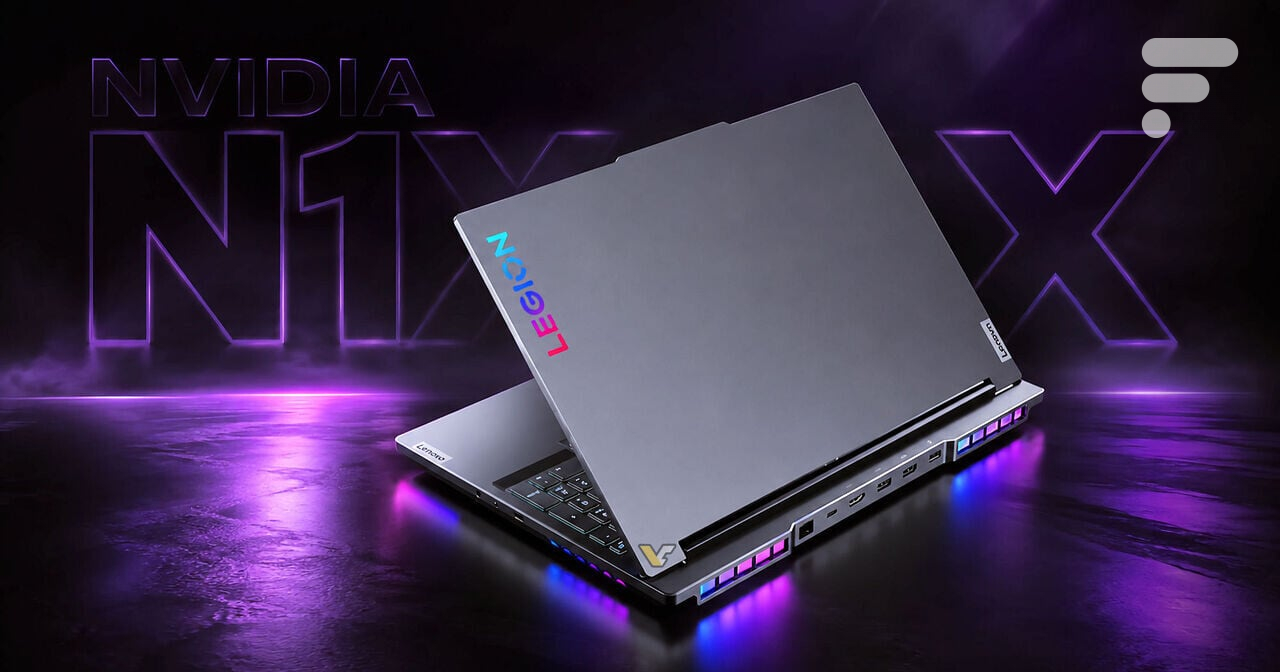
On one of Lenovo’s portals, two entries called “NVIDIA N1x Portal PROD” and “NVIDIA N1x Portal Test” were spotted by Videocardz. Which means that the manufacturer accidentally confirms that it is indeed preparing laptop PCs powered by Nvidia’s future ARM chip.
And this is not the first leak. In early 2026, a shipping manifest already mentioned a Dell 16 OLED equipped with an “ES2” sample of the N1X, and a motherboard labeled “NVIDIA N1 AI book engineering sample” even surfaced on Goofish, Alibaba’s online flea market.
To go further
What is this mysterious Nvidia motherboard? We explain to you
The N1X is the chip that Nvidia is designing with MediaTek to attack the laptop market. Its CEO Jensen Huang sold the fuse at the start of the year: ARM architecture, and in his words, a chip designed for “low consumption and excellent performance”.
Mowing your garden is no longer a chore in 2026!
What if you entrust the mowing of your garden to a robot lawn mower? Currently, the LUBA 3 AWD 5000 model comes with a great gift: a free Standard Garage (worth €199)!
According to Tom’s Hardware, we are talking about a SoC with 20 ARM cores (10 performance, 10 efficiency), coupled with a Blackwell GPU with 6,144 CUDA cores, which is as much as a desktop RTX 5070. The connection is clear: this N1X derives from the GB10 Grace Blackwell which powers Nvidia’s DGX Spark mini-supercomputer, already capable of running AI models with up to 200 billion parameters locally on a desktop.
The Windows bet on ARM, again and again
But what is at stake? Nvidia is entering a market of around 280 million PCs per year (according to IDC and Gartner figures for 2025), locked by Intel and AMD on the x86 side, and disrupted on the ARM side by Qualcomm’s Snapdragon X recently.
The promise: an integrated GPU strong enough to run games, creation and especially generative AI models locally, without a dedicated graphics card, with ARM-style autonomy as a bonus.
The problem is Windows on ARM. The system remains a permanent work in progress: emulating x86 applications costs performance, certain peripherals still pose problems, and Microsoft will have to tighten the bolts on the driver side before release.
According to Notebookcheck, which cites leaker Moore’s Law is Dead, Nvidia would show the chip at Computex from June 2 to 5, but the first machines would not be released until October 2026, with real availability in early 2027.
The balance of power with ARM competition will quickly become tense: Qualcomm is preparing its Snapdragon X2 Elite Extreme, and Apple the M5 Pro. Any additional slippage of the N1X beyond the fall of 2026 would cause it to land opposite platforms already installed on their second cycle.
According to the Lenovo portal, it is the Legion 7, a gaming PC, which would inaugurate the chip, where previous leaks targeted IdeaPads and Yogas more focused on productivity. If the figures hold, Nvidia has the first ARM chip capable of playing seriously in the x86 league. Provided that Microsoft has finished retyping Windows on ARM by release. Or else… maybe there is something on the Linux side. Who knows.