By the winter of 1941 there was one question that dominated American life and politics: would the country enter World War II? At that moment in the war in Europe, France had fallen and the German bombers were attempting to force England into submission.Â
What could not be known was that Hitler and his field marshals were deep in planning for the spring and an invasion of the Soviet Union, with which it had signed a non-aggression treaty in 1939. On the other side of the world Germany’s Axis partner Japan was also making plans to take on America in the Pacific by attacking the Navy’s fleet at Pearl Harbor.
What the members of the Allentown Chamber of Commerce were hoping to hear as they gathered on the crisp cold evening of February 28, 1941, was the perspective of newspaper man Peter C. Rhodes of the United Press. Also present on the dais that evening was Pennsylvania Republican Governor Arthur James. The meeting took place at the Allentown National Guard Armory at 15th and Allen streets.
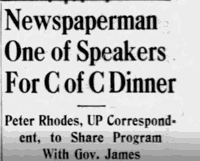
To judge from a picture taken of Rhodes that night, what the members of the chamber saw was a boyish-looking 32-year-old in formal wear. But the story he had to tell was one of a life lived on the edge of a world in turmoil and conflict.
According to the Morning Call article, Rhodes was born in 1911 in the Philippines. Rhodes’ Wikipedia entry says it was September 18, 1909. He had been educated in the United States at Columbia University. Awarded a fellowship, he spent two years at Oxford.
Although Rhodes was on an academic path, he apparently decided that he wanted to see something of the world. In 1936 he took a job with the United Press in London. “During the next three years he worked on assignments out of London, Paris, Copenhagen and Stockholm,†the Call noted.
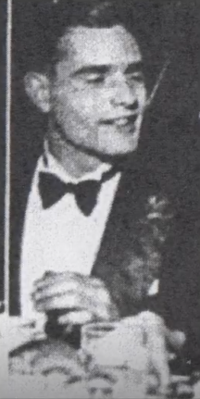
Peter Rhodes as he appeared in the newspaper account of his visit to Allentown, 1941
Rhodes’ first war reporting came when Soviet Russia attacked Finland in late 1939. Called the Winter War, it is mainly remembered for the way skillful and outnumbered Finns were able to take on the vastly larger Soviet forces by their knowledge of fighting in the cold and snow.
Rhodes was in Stockholm when Germany attacked Norway in 1940 and was present for the battle of Navik, a port city. This assault by the Germans was countered by a joint British, French, and Polish force.
It was eventually won by the Germans and Norway was placed under the rule of a puppet government by a Nazi sympathizer, Vidkun Quisling. The word quisling became, largely at the instigation of Winston Churchill, a synonym for traitors during World War II.
“After the Battle of Navik,†reported the Call, “Rhodes skied to the Swedish frontier town Abisco to be the first correspondent to get through to the outside world an eye-witness account of the German occupation of the far-northern seaboard. For the rest of the invasion Rhodes shuttled back and forth across the Norwegian border reporting his dispatches through Stockholm for one of the most remarkable records of modern war correspondence,†reported the Morning Call.
The newspaper went on to note that after his time in Scandinavia, Rhodes returned to America by the only route open to him. After arriving in Moscow and witnessing the Soviet annexation of the Baltic states of Latvia, Estonia and Lithuania, he took the Trans-Siberian Express across the continent to Vladivostok. From there it was a ship to Toyoko and across the Pacific to San Francisco.
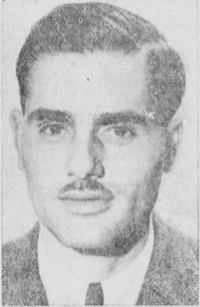
Peter Rhodes picture, as it appeared in several newspapers in the early 1940s
“On Aug. 2 he returned to the New York cable desk and his eye-witness experience and his thorough knowledge of European politics to the job of covering Europe for American readers.â€
There is no doubt that young Peter C. Rhodes impressed the Allentown Chamber of Commerce. In that world at war Americans had one thought: will we end up in it? Many feared that like World War I the nation would be drawn into war. Hitler’s blitzkrieg had rapidly conquered France, more rapidly than anyone had imagined.
It was a time when more people were coming to depend on the newspaper and radio correspondents to explain what was going on in the world. Edward R. Murrow was dodging bombs in London and William L. Shirer was doing the same in Berlin. One little remembered today was Webb Miller, a veteran UP reporter who also covered World War I and died in London on his way to cover an air aid during the blitz. He wrote a memoir just before his death titled “I Found No Peace.â€
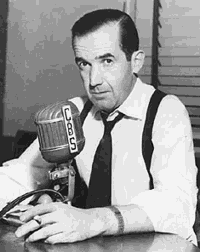
Edward R. Murrow, 1954
Americans were having a war in Europe brought home to them in a way it never had been before. Alfred Hitchcock summed it up in his thriller, the 1940 film “Foreign Correspondent†with actor Joel McCrea as the naïve American reporter thrust into European intrigue and war.
Today thanks to Wikipedia and other sources we know more about Peter Rhodes than he was letting on to the members of the Allentown Chamber of Commerce. Born in the Philippines, his father was Christof Beutinger, a German born coal merchant and former army officer with the U.S. Army in the islands. His wife was Margaret Claire Abrams, a native of Jamaica in the British West Indies. Rhodes had four siblings, Frederick, William, Margaret and Marie.
An event that may very well have shaped Rhodes’ life took place on July 12, 1916. They were living in Caldwell, New Jersey, when his mother shot and killed his father. An article in the next day’s New York Times gives an account of many years of abuse by Rhodes’ father. A trial held in December 1916 found her not guilty of all charges.
The family moved to New York where eventually Rhodes attended Columbia University between 1929 and 1933. In June 1934 he graduated with a master’s degree. A Kellett fellowship of $2,000 enabled him to travel to England and attend Oxford University where he had an excellent record.
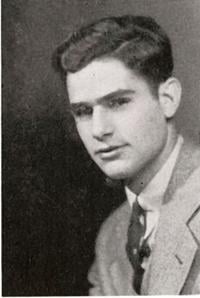
Peter C. Rhodes, Columbia University 1933
In 1936 while traveling in Europe he met a young schoolteacher in Belgium, Ione Boulenger, who became his wife. They were to have three children. In the 1940s they were living at Knickerbocker Village in New York City, a pioneering housing project that was later the focal point of the first landlord tenant laws. Later around 1946 they moved to Amenia, Dutchess County, New York.
On leaving Allentown the United Press sent Rhodes to London to cover the Nazi blitz. On his return he apparently took on government employment and went to work for the Federal Communications Commission. Later with America’s entry in the war, he was chief of the Atlantic News Service of the Office of War Information.
After the war, according to one source he was “head of monitoring for Psychological Warfare for the Air Force.” At roughly the same time, in 1952, Rhodes wrote a book, “Beautify Your Home Grounds,” apparently to help budding suburbanites turn their rancher or split-level into something more than a development dwelling with a stick-like tree in front of it.
But over the years rumors began to circulate that Rhodes had other interests than the care and feeding of Rhododendrons. As early as 1942 his name had been circulating on a list by the House Committee on Un-American Activities as a delegate of the International Coordinating Committee for Aid to Republican Spain. Being anti-Franco was suddenly un-American.
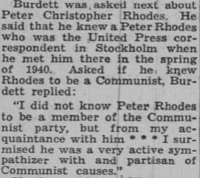
Newspaper account mentioning Peter Rhodes’ alleged Communist inclinationsÂ
It was in 1949 that Rhodes’ name appeared again in the testimony of FBI informant Elizabeth Bentley, dubbed by newspaper headline writers almost universally as the “Red Spy Queen,†that he was one of the federal employees “involved in giving information to the Soviet Government.†In 1952 John Lautner told the Senate Internal Security Committee he knew Rhodes was a “former Communist…in charge of intelligence for the Military Government in the Mediterranean.â€
As late as 1955 Rhodes’ name was still circulated as a supposed “Red.†Testifying before a Senate committee, CBS broadcast journalist Winston Burdett, whose hushed voice from the Vatican generations of listeners would come to associate with the death of Popes, would testify it was his impression that Rhodes was a “very active Communist sympathizer and partisan of Communist causes.†Burdett said he formed his opinion from “my acquaintance with him and particularly his activities.â€
As far as can be easily ascertained, Rhodes never made any response to any of these accusations. Perhaps because they were true or perhaps because they were not and he did not think they were worth responding to. Maybe he was just posing as a Communist to infiltrate the Reds. It’s a shame Hitchcock isn’t around to do something with this one. According to his Wikipedia entry Rhodes passed away in September of 1965 in Monroe County, Florida at age 56 taking his secret, if there was one, to his grave.