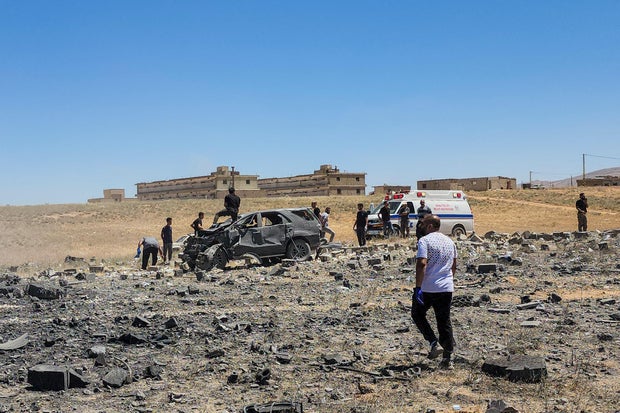
The situation has been deadlocked: direct talks in Islamabad on April 11 were unsuccessful, with significant disagreements remaining, from the Strait of Hormuz to the nuclear issue. Iran has transmitted a new text this week through Pakistan, but no details have been revealed.
Donald Trump said he was “not satisfied” with the proposal. While he had previously threatened to “destroy” the Iranian civilization, he added that he would prefer not to “completely obliterate” Iran, but that a return to war remained “an option.” “A resumption of conflict between Iran and the United States is likely and the facts have shown that the United States do not abide by any promises or agreements,” reacted Mohammad Jafar Asadi, deputy inspector of the Iranian armed forces Khatam Al-Anbiya, quoted by the Fars news agency.
Continuation of the war or diplomatic path, Tehran is “ready” for both scenarios and “the ball is in the court of the United States,” judged Kazem Gharibabadi, Vice Minister of Foreign Affairs.
“Humiliation” Donald Trump theoretically had until Friday to request authorization from Congress to continue the war. He chose to send a letter to parliamentary officials notifying them that hostilities against Iran were “over,” even though several Democratic lawmakers pointed out that the continued presence of forces in the region indicated otherwise.
While the bombings have stopped, the conflict persists in other forms: Washington is imposing a blockade on Iranian ports in response to Tehran’s closure of the Strait of Hormuz, through which a fifth of the world’s consumed hydrocarbons used to pass. The repercussions of the conflict continue to shake the global economy, with oil prices reaching unprecedented levels since 2022.
While the American president is outraged by the lack of support from Europeans, the Pentagon announced the withdrawal of some 5,000 troops from Germany within a year. The president was particularly annoyed by remarks from Chancellor Friedrich Merz stating that Americans had “no strategy” in Iran and that Tehran was “humiliating” the world’s leading power.
New tariffs? On Friday, Donald Trump indirectly criticized Germany and its significant automobile exports by announcing his intention to raise tariffs on imported vehicles from the European Union to 25% “next week.” He accuses the EU of not adhering to the trade agreement reached last summer, even though the approval process for this agreement has not yet been completed within the bloc of 27.
“The European Union is ‘implementing the commitments made’ with Washington ‘in accordance with regular legislative practices, keeping the American government fully informed throughout the process'”, reacted its delegation in Washington. If the United States do not fulfill their part of the agreement, she added, “we will keep all options open to protect EU interests.”
Such American surcharges would lead to “enormous costs for the German and European automotive industry, already facing very difficult conditions,” said Hildegard Müller, president of the German automotive lobby (VDA), in a statement yesterday. She urgently called for both parties to de-escalate and quickly open negotiations.
/2026/06/16/6a30e890a0c81564235057.jpg "Environ \"120 millions de barils encore coincés\" dans le détroit d'Ormuz, selon un expert")