By Diana Mandia
European stock exchanges ended sharply lower on Thursday, as investors took a cautious approach following a significant surge on hopes of a resolution to the conflict in Iran. The question of navigating the Strait of Hormuz could take time to resolve.
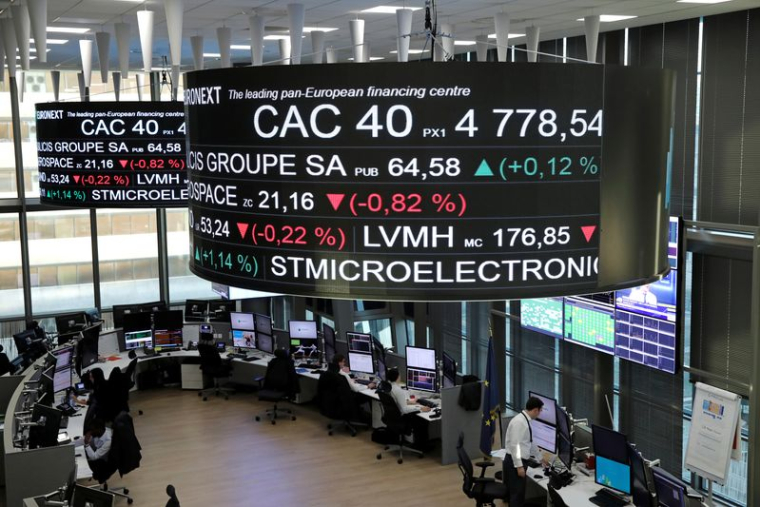
In Paris, the CAC 40 lost 1.17% to 8,202.08 points. In Frankfurt, the DAX fell by 1.02% and in London, the FTSE 100 dropped by 1.55%.
The EuroStoxx 50 index ended down 0.90%, the FTSEurofirst 300 lost 1.12%, and the Stoxx 600 declined by 1.10%.
According to sources and officials, the United States and Iran are approaching a temporary agreement to end their conflict without immediately resolving the issue of reopening the Strait of Hormuz, which would be addressed in a later phase.
Oil prices continued to decline on Thursday, slightly easing inflation concerns and boosting government bonds. However, European investors remained cautious, leading to volatile trading sessions.
The week was marked by new changes in the White House, particularly regarding an escort mission in the Strait of Hormuz that was quickly abandoned. Many uncertainties remain about the normalization of the Middle East’s energy market, which is more crucial for Europe than the United States.
European markets lagged behind global counterparts, as optimism about artificial intelligence (AI) drove other major indices higher, especially in Asia and the United States. The S&P 500 and Nasdaq hit record highs in recent days.
Investors also analyzed a wave of data and forecasts from European companies on Thursday amid sectoral uncertainties.
While energy sector profits skewed the average – set to soar by 48.4% in the first quarter due to rising oil prices – other companies are expected to post a 5.7% increase compared to the same period last year, based on LSEG I/B/E/S data.
Oil: Oil prices continued to decline on Thursday, but at a slower pace. The global benchmark Brent remained below $100 per barrel, with hopes of a peace deal between the United States and Iran.
Stocks: In Paris, Bouygues dropped 3.66%, Engie fell by 2.58%, while Trigano rose by 1.96%. Luxury sector stocks climbed 1.25%, supported by optimism about the Middle East. LVMH, Hermès, and Kering were among the top performers in the CAC 40.
Elsewhere in Europe: Solvay fell by over 7% after reporting lower organic Ebitda in the first quarter, citing price and volume declines, unfavorable currency effects, and transformation expenses. Campari plunged by 14% in Milan after disappointing first-quarter sales.
Defense sector: The defense sector suffered a 2.69% decline, partly due to tax and budget pressures in Germany and Rheinmetall’s sharp drop of 6.9%.
Wall Street: U.S. stock indices moved mixed on Thursday, with the Dow Jones down 0.16%, while the S&P 500 and Nasdaq Composite advanced by 0.12% and 0.51% respectively.
Indicators for the day: Retail sales in the eurozone fell by 0.1% in March, less than expected. In the U.S., the number of initial jobless claims increased less than expected last week, indicating a low layoff rate.
Currency: The dollar weakened by 0.10% against a basket of reference currencies for the second consecutive day, driven by hopes of de-escalation in the Middle East conflict favoring oil-exposed currencies. The euro gained 0.15% to $1.1765.
Bonds: Eurozone sovereign bonds had a mixed performance on Thursday, with German Bund yields almost stable at 2.9971% for ten years, while the two-year bond yield rose slightly to 2.5734%. In the UK, operators awaited local election results that could impact the future of Labour Prime Minister Keir Starmer, affecting concerns over budget issues.
Treasury Yields: U.S. Treasury yields slightly declined but remained stable as European markets closed. The ten-year Treasuries stood at 4.3600%, and the two-year at 3.8780%, both seeing slight increases.
Federal Reserve Cleveland President Beth Hammack mentioned in an interview on Thursday that the U.S. central bank is expected to keep interest rates unchanged for an extended period amid high uncertainty.