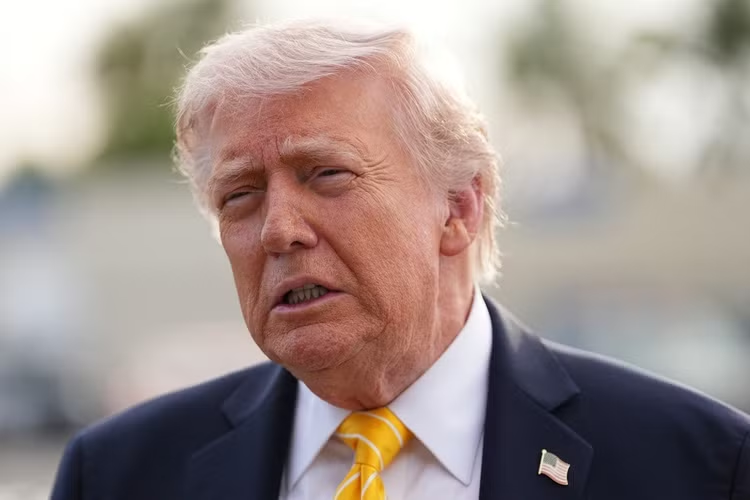
President Donald Trump has always presented himself as a master negotiator, but he seems to be at an impasse with Iran as his aggressive rhetoric, threats, and even military action have failed to change Tehran’s long-standing position, according to AP.
Despite constantly shifting goals, President Trump and his top advisors have maintained that the United States has won the war and that Iran was ready to make a deal, following an escalation of threats in the context of a fragile ceasefire.
The United States’ top priority has not been achieved.
On May 18, President Trump announced that he had temporarily suspended his planned attack on Iran at the request of Gulf countries, as “serious negotiations are currently underway”.
Despite canceling the planned airstrikes on May 19, Trump maintained a tough stance, stating that he had ordered military leaders to be “ready to launch a large-scale attack against Iran at any time, if no acceptable agreement is reached”. President Trump has set and withdrawn ultimatums to Tehran several times.
Despite internal instability, a struggling economy, and the deaths of many leaders, there is no indication that Iran will comply with President Trump’s demands.
In fact, Iran has shown even more rigidity. As a result, Trump’s main objectives remain out of reach: Iran has not agreed to abandon its nuclear program, its development of ballistic missiles, or to end its support for proxy forces in the region, notably in Gaza, Iraq, Lebanon, and Yemen.
The White House defended President Trump’s approach on May 18, stating that “Trump’s priority has always been peace and diplomacy,” but he would only accept an agreement that puts American interests first.
“President Trump has all the cards in hand and keeps all conditions on the negotiating table to ensure that Iran never possesses nuclear weapons,” said spokeswoman Olivia Wales in a statement to the Associated Press.
Iran holds the advantage in the Strait of Hormuz.
A crucial point, Iran has retained control of the Strait of Hormuz, a vital global maritime route for oil transportation, despite the blockade imposed by the US military on its ports. The resulting disruptions in global energy markets have led to a surge in gasoline prices, penalizing American consumers and posing a potential risk to the Republican Party as midterm elections approach in November.
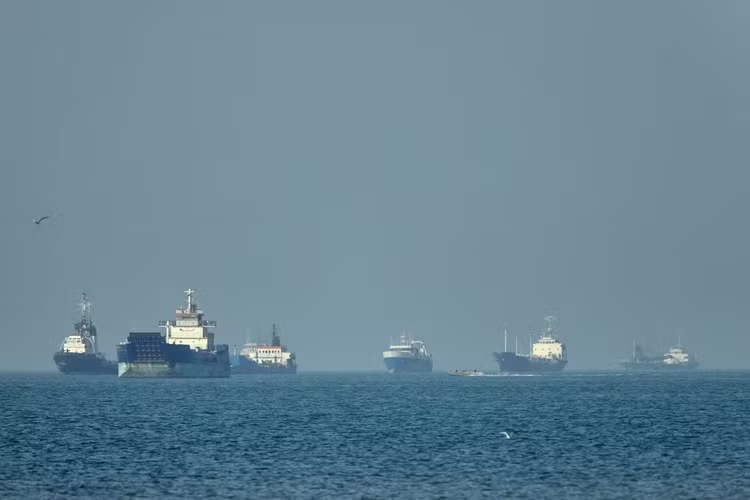
Trump’s strategy of increasing pressure – economic and military – to force foreign governments to make concessions has not been as effective in Iran as in Venezuela and elsewhere, according to AP. The US does not have as powerful leverage as Iran’s control of the Strait of Hormuz.
The war in Iran has raised the cost of living for Americans, resulting in a decline in Trump’s popularity on economic issues, even within the Republican Party, with confidence in his leadership diminishing, according to an AP-NORC poll conducted last month.
Neither team has admitted defeat.
Ali Vaez, director of the Iran project at the International Crisis Group, noted that neither the US nor Iran see themselves as losers in this ongoing conflict.
Since the ceasefire came into effect, Washington and Tehran both seem to believe that time is on their side: each side thinks that a blockade and counter-blockade in the Strait of Hormuz will increase costs for the other, while creating conditions for a possible resumption of the conflict,” observed Vaez.
Despite the impact of the American economic pressure campaign, Iran has not been weakened enough to accept demands it views as a “surrender,” Vaez said.
David Schenker, former Deputy Assistant Secretary of State for the Middle East during Trump’s first term, who now works at the Washington Institute for Near East Policy, described the current situation as a “stalemate.”
He suggested that President Trump may be “hesitant” to re-engage in a large-scale military conflict, especially due to concerns from Gulf Arab states about potential Iranian reprisals and the volatility of energy markets, which could have political repercussions in the US.
At the same time, Rich Goldberg, a hardliner on Iran who served on the US National Security Council under both of Trump’s presidencies and now works at Foundation for Defense of Democracies, claims that the US remains in a position of strength, particularly due to an advantage in the Strait of Hormuz.
Goldberg, particularly concerned about the US energy situation, argues that reopening the Strait of Hormuz would help alleviate the “service station anxiety” felt by many Americans, but it is not critical.
>>> Readers are invited to watch other videos on the Strait of Hormuz.
Source: https://khoahocdoisong.vn/chinh-sach-doi-ngoai-cung-ran-cua-ong-trump-gap-be-tac-voi-iran-post2149100784.html