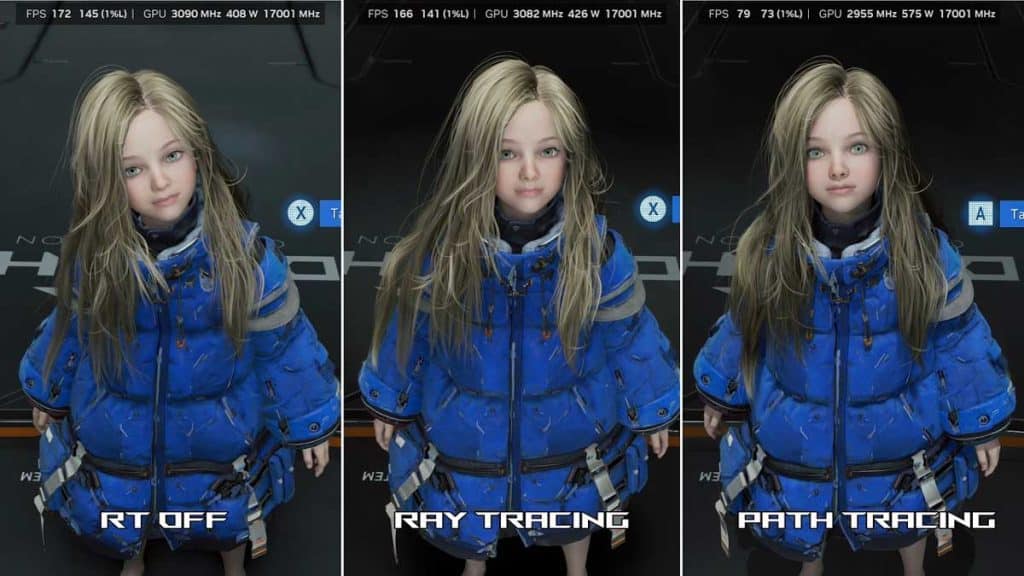
NVIDIA continues to evolve real-time graphics rendering with a major new advancement around path tracing. Baptized ReSTIR PT Enhancedthis technology from its research laboratories promises significant performance gains, with rendering up to 2 to 3 times faster while improving visual quality.
NVIDIA ReSTIR PT Enhanced: a key evolution of modern path tracing
Path tracing, often considered the ultimate evolution of ray tracing, allows you to simulate realistic light behavior by taking into account multiple bounces and complex interactions with surfaces. But this precision comes at a huge cost in resources, which further limits its large-scale adoption in video games.
With ReSTIR PT EnhancedNVIDIA no longer seeks simply to increase raw power, but to deeply optimize the algorithm itself. The objective is clear: extract maximum visual information from a very limited number of samples, while reducing artifacts and temporal instabilities.
Strongly improved performance and better image quality
According to published data, this new version makes it possible to drastically reduce the computational cost of path tracing thanks to better management of the spatio-temporal reuse of data. Concretely, this translates into:
- An acceleration of up to 3 times current performance
- A notable reduction in visual noise and digital errors
- Better image stability, especially in dynamic scenes
- More efficient management of direct and indirect lighting
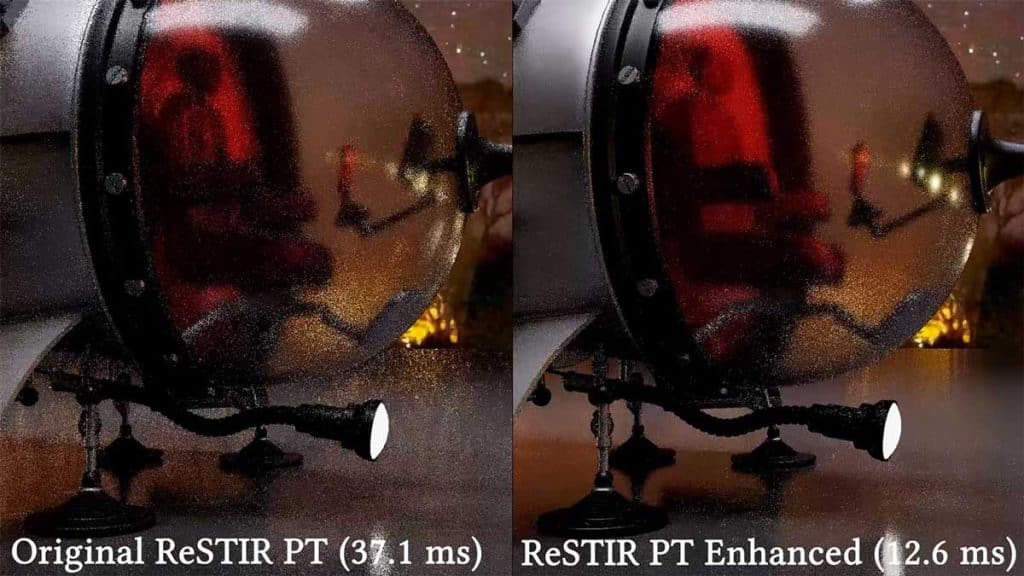
These improvements provide cleaner, more consistent rendering, even with few samples, which is essential for real-time use.
A technology that is part of the RTX ecosystem
ReSTIR PT Enhanced is a continuation of the work carried out by NVIDIA for several years. After DDGI in 2019, ReSTIR in 2020 for direct lighting, then ReSTIR GI in 2021 for indirect lighting, this new iteration strengthens the entire modern rendering chain.
The technology is already linked to tools like RTX Kit or even modified versions of the Unreal Engine via the NvRTX branch. It aims to make path tracing more accessible to developers, especially for complex scenes with global lighting, advanced reflections and realistic materials.
Not yet a replacement for current technologies
Despite these advances, NVIDIA is not replacing its current pipeline. Technologies such as DLSS, denoisers or image reconstruction systems remain essential. ReSTIR PT Enhanced rather reinforces the overall efficiency of rendering by improving one of its fundamental building blocks.
In other words, it is not an isolated revolution, but a profound optimization which makes the entire system more efficient and more stable.
Adoption still uncertain in games
For now, ReSTIR PT Enhanced remains a research technology. If its integration into the RTX ecosystem seems logical in the long term, no precise date has yet been announced for its adoption in commercial games.
But one thing is certain: with this type of innovation, NVIDIA continues to push the limits of real-time rendering, bringing video games a little closer to cinematic rendering each year.