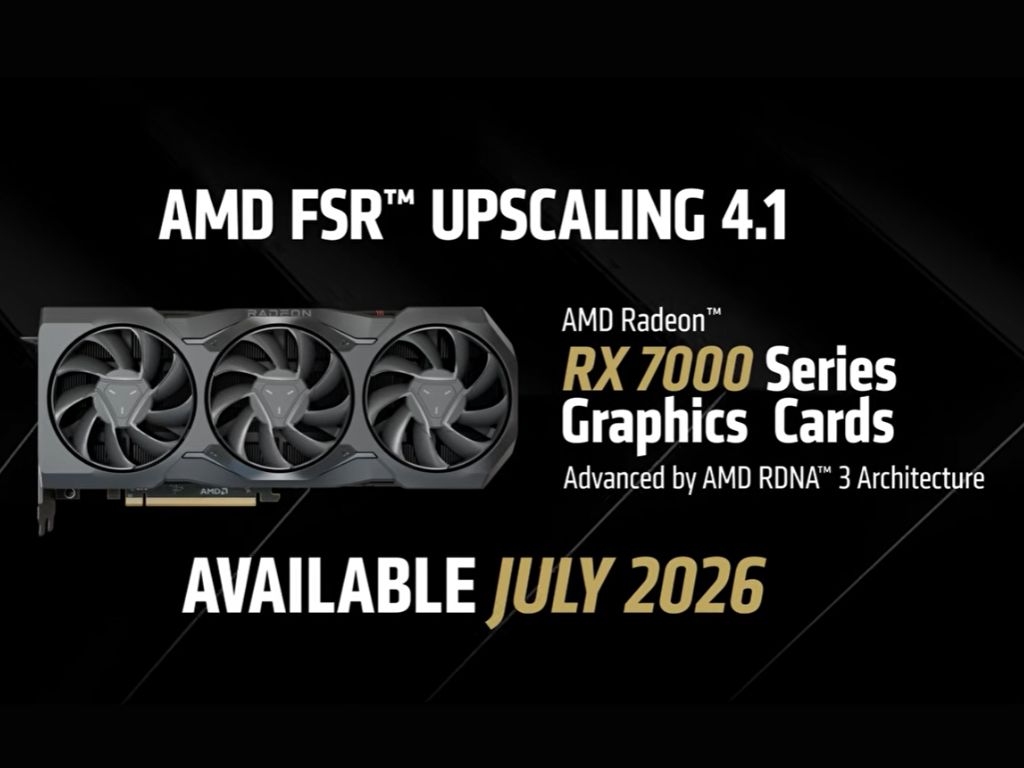
AMD is preparing an update that should interest many PC players. In a video announcement released yesterday, Jack Huynh, senior vice president and general manager of Computing and Graphics GroupAMDconfirmed the arrival of FSR Upscaling 4.1 on RDNA 3 GPUs, i.e. Radeon RX 7000 series graphics cards. Deployment is planned for July via a simple Radeon driver update. The information has since been relayed by several specialized media, which also confirm the later arrival of this technology on RDNA 2.
Until now, this new generation of machine learning-based scaling has remained primarily associated with the most recent Radeon GPUs. With this announcement, AMD therefore broadens its access to a previous generation of graphics cards, without forcing players to change hardware. For Radeon RX 7000 owners, the interest is direct, obtaining a sharper image and enhanced fluidity in compatible games.
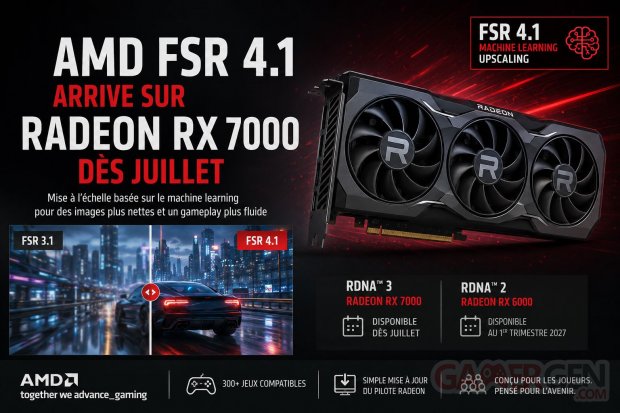
FSR, for FidelityFX Super Resolution, allows you to calculate a game in a lower definition before reconstructing the image in a higher definition. The objective is simple, improve performance while maintaining clean visual quality. With FSR 4.1, AMD places greater emphasis on machine learning-assisted upscaling, an approach that aims to reduce artifacts, improve image stability and deliver more accurate rendering in moving scenes. This development brings Radeon technology a little closer to competing solutions which already use artificial intelligence to improve the image.
The manufacturer announces compatibility with more than 300 supported titles. The exact gain will obviously depend on the games, the graphics settings, the definition used and the model of graphics card installed in the machine. The advantage for players is that this update will not require complex handling, since it will involve installing the latest Radeon driver. Official drivers remain available from the support pageAMDwhich offers downloading for Radeon graphics cards on Windows and Linux.
This announcement is also important for the image ofAMD. Players who have invested in a Radeon RX 7000 may have feared seeing certain new software features reserved for more recent models. By opening FSR 4.1 to RDNA 3, the manufacturer shows that it intends to extend the lifespan of its graphics cards and maintain a more coherent Radeon ecosystem. This is a positive signal for users who do not wish to renew their configuration each generation.
The roadmap does not stop there. AMD also plans to extend FSR Upscaling 4.1 to RDNA 2 GPUs in the first quarter of 2027. Radeon RX 6000 cards should therefore also benefit from these improvements, but with several months lag compared to the Radeon RX 7000. This second stage could concern a large base of players, since RDNA 2 still remains very present in many PC configurations. Several sources also indicate that this extension could be of interest for certain devices based on this architecture, even if performance and availability will depend on final software support.
For developers, this openness may also make it easier to integrate FSR into more games. The more the base of compatible GPUs increases, the more relevant the technology becomes to take into account in the graphics options. AMD would also like to reiterate its commitment to players and studios, with the objective of providing recent tools to improve the gaming experience without systematically imposing hardware development.
It now remains to be seen how FSR 4.1 will perform in practice on the Radeon RX 7000, then on the Radeon RX 6000 in 2027. The promises are interesting, but frame by frame comparisons will make it possible to measure real progress in terms of sharpness, temporal stability and fluidity. On paper, this announcement remains good news for the Radeon ecosystem, especially at a time when the lifespan of graphics cards becomes an argument as important as their raw power.